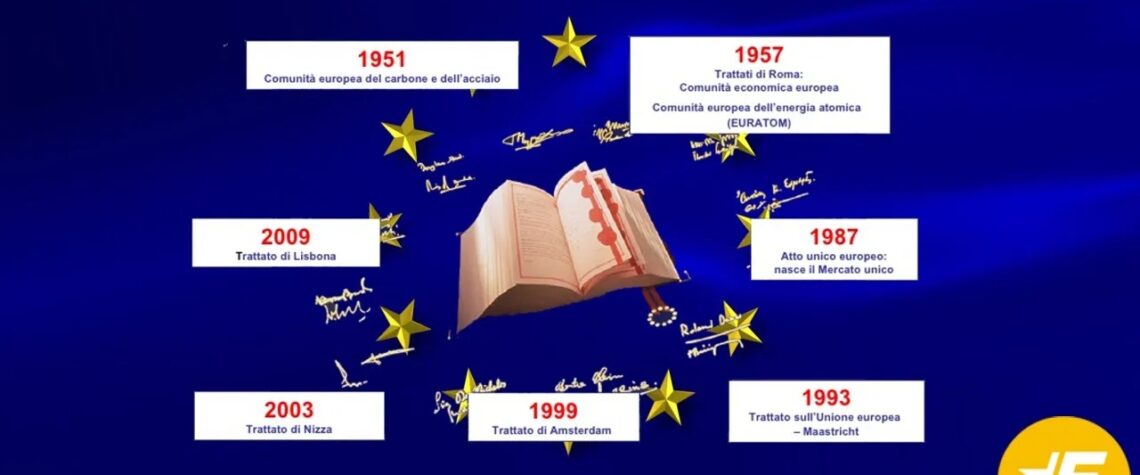
This is the sixth lesson of the first module of the EUPress teacher training by Professor Fabio Masini on the process from the Treaty of Amsterdam to the Treaty of Lisbon and the relative consequences for the European integration.
The trajectory from the Treaty of Amsterdam (1997) to the Treaty of Lisbon (2009) traces one of the most complex and consequential transitions in the history of European integration — a journey that reveals both the ambition of a united Europe and the structural weaknesses that still haunt it.
The euro: a political leap without a political foundation
The launch of the euro in January 1999 — and its physical introduction in 2002 — was more than a monetary milestone. As the lecturer underscores:
“Each time a group of countries gives up sovereignty over its currency, it is a political step.”
Yet this monumental leap was not accompanied by a matching political vision. The euro was treated predominantly as a technical instrument, without fully acknowledging its implications for shared governance, fiscal solidarity, or democratic legitimacy.
The failed attempt at a European Constitution
Recognizing the contradiction of a shared currency without shared political power, the EU launched a process to draft a European Constitution in 2001. The goal: to strengthen institutional legitimacy and create a common identity among citizens — especially as the Union prepared for its historic enlargement to 10 new countries in 2004.
But the project faltered because:
- It felt like “just another treaty,” rather than a true constitution expressing a common will.
- The ratification process was decentralized — leaving each member state to decide how to approve it.
- Political dynamics overshadowed substance: in 2005, France rejected the text in a referendum not due to its content, but as a protest against the government.
With France and later the Netherlands voting “No,” the constitutional project collapsed. Integration retreated into a treaty-revision logic.
What came next: the Nice–Lisbon sequence and the return of intergovernmentalism
After the constitutional setback:
- The EU adopted the Treaty of Nice (2001) — focusing mainly on institutional adjustments for enlargement, with limited political ambition.
- In 2007, the Treaty of Lisbon replaced the failed constitution. Though functionally similar, it avoided the symbolic language of statehood and emphasized national sovereignty.
Lisbon marked a clear shift:
“Lisbon is more intergovernmental than Maastricht — and Maastricht was already more intergovernmental than what came before.”
By strengthening the role of the European Council and retaining unanimity in key areas, Lisbon made intergovernmentalism the de facto steering logic of the Union.
A crisis hidden in plain sight: oil shock and speculation
At the same time, unexpected global events reshaped Europe’s economic context:
- The terror attacks of 9/11 triggered wars in Afghanistan and Iraq.
- An unprecedented oil shock (2001–2008) pushed prices from $18 to $144 per barrel — an 8-fold increase, twice as severe as the 1970s crisis.
- Thanks to a strong euro, the European Central Bank shielded the continent by revaluing the currency against the dollar — reducing the real cost of energy imports.
Yet public perception did not reflect this economic defense. Governments — especially in Italy — failed to monitor the price transition during the euro changeover, allowing inflation and speculation to erode household purchasing power and deepen mistrust in the new currency.
By 2007: A fragile structure meets a global storm
On the eve of the global financial crisis:
- The eurozone was economically resilient,
- But politically fragile — lacking a fiscal union, a constitution, and a shared decision-making core.
American economists had already warned:
“You are not a federation. You don’t have a political ownership of the euro. In case of major shocks, you will have problems.”
They were right. The 2007–2008 financial crisis exposed the structural gaps between the EU’s ambitious monetary integration and its weak political foundations — a paradox that would define the next decade of European governance.
From Amsterdam to Lisbon, Europe’s journey reflects the persistent challenge of building shared sovereignty without shared statehood. A half-completed union, increasingly reliant on intergovernmentalism, faced a storm it was never fully equipped to withstand.